When life gives you lemons?
When life gives you lemons?

Christ’s Entry into Brussels in 1889. James Ensor.
Superbowl weekend always opens my Miller High Life memory can and releases a rather unhappy, rather rank-tasting foam from Superbowls past, maybe because I’ve been at too many Superbowl parties with too many drunk people. Don’t get me wrong: I love the game, except maybe when the Packers lost in 1998 or last year, when I had the winning numbers for the final square with a few seconds to go and was about to win something like 750 bucks and the goddam Steelers scored and sure, sure, they were happy, the city of fucking Pittsburgh was happy, but what about me? On the threshold of winning 750 bucks? Grim, grim situation. I keep thinking if only I had gotten up from my chair and been standing behind the bowl of cheese doodles at the snack table, if I hadn’t been sitting where I was sitting when the Steelers connected for the final victorious score, the universe would have been different, the alignments would have changed, and that 750 bucks would have been mine.
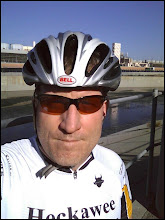
You may well ask what the hell happened to the random picture that bears no relation to the text that appears underneath it? You may say, “Mag, have you really gotten so goddam lazy in your forty-sixth year that you can’t step outside and take a stupid, probably blurry snapshot and go back inside, download the picture on to your laptop and upload it to Mag’s Sentence?” I may respond with some friendly, loving remarks of this nature: “If you’re so great, why don’t you try it?” You obviously are trying it – most everybody these days is – and the chances of you living a more efficient and artworthy life than me are vast indeed.

It ain’t no picnic. Let me say that from the start. In my best days of cycling, back in the day, back when I was a forty-year-old Category IV Heckawee superstar in rural southern Illinois, cycling was a matter of suiting up, saddling up, rolling down the street for a couple of minutes and then pedaling along essentially empty roads for hours on end. If two or three cars would pass in a thirty-minute period, we would often complain that the road had become a bit too ‘trafficky’ for our tastes, and we would seek, and easily find, quieter roads. We were happy cyclists indeed. What an inspiring time that was! Here in Los Angeles, however, a quiet road seems to be one where you can manage to pedal thirty seconds without narrowly escaping certain death from any one of the twenty-five million automobiles and trucks that cram the Los Angeles streets at all hours of the day. Sure, the city has provided bike lanes and erected numerous signs indicating the existence of bike lanes and bike routes. Sure, huge numbers of cyclists manage to ride on a daily basis here: commuters, racers, homeless people, hipster single-speeder douchebags with skinny jeans and no helmets, et cetera. But me? The great pumpkin on a cyclocross bike? I’m scared shitless every time I roll down the street.

A sweet dog. Friendly. Obedient. As pure at heart as Karen in Frosty the Snowman used to be before the big lug melted in that desolate greenhouse on that horrible Christmas Eve all those years ago. Sure, Santa reconstituted Frosty, and Frosty said, “Happy birthday,” but Karen never got over the trauma and her cheery life never regained its spring. I saw Karen a few weeks ago, predictably enough on Hollywood Boulevard, standing outside Musso and Franks. She wasn’t coming out or going in – just occupying a space on the sidewalk and smoking a cigarette. She looked great, for a 46-year-old woman with enough problems to fill a few dozen Greyhound busses and drive them into the desert and leave them there till the vultures pick the bodies clean.

This week’s been hard for me, as you know, on account of some soft-tissue issues that are either going to sort themselves out or they aren’t. In the meantime, I’m saddling up and taking the tissues for a test ride, just to see how things are progressing, and when I get back from my ride – if I get back, that is – I’m spending the rest of the day on a super-secret and ultra-pointless writing project, which is the kind of writing project I like best.
I’ll be back with new Mag’s Sentence stuff tomorrow.
For the moment, I’ll close with a ridiculous motivational quote a number of cyclists have been passing around this week: “Success, like happiness, comes as a by-product of work…concentrate on the work and allow the rewards to come, or not come.” I guess a genuine joy-bundle named S. Pressfield wrote that or said that or whatever.
Please don’t take heed to that kind of Pure-D bullshit, people. Be happy first, then worry about your work.
Happy riding and writing, everyone.

One curious aspect of language is that even when you’re in no mood to be amused by it, even when your life is broken down and stranded along the cluttered, infomercial-lined roadside on the highway to happiness, you’ll hear a particular word, catch a particular phrase, and something about it will take the droop right out of your demeanor and you will no longer give a hootski that your circumstances aren’t perfect. When I was a boy, for instance, I was prone to feeling oppressed most of the time, which meant I was perfectly normal and perfectly inclined to sink into the mopes when I had been sentenced to a week’s solitary confinement in my room after I had committed an atrocity like shitting on a ham sandwich and placing it in my piano teacher’s mailbox or taking it upon myself to urinate on the Jane Austen section at the Thomas Jefferson Middle School Library [Ed. Note: despite psychological evidence to the contrary, Mag is not, nor has he ever been, a serial killer. Also, Mag tries to keep the scatological references to a minimum – he’s even in therapy to prevent this sort of subject from continually gurgling to the surface of his writing – but he apparently isn’t trying hard enough]. Particular offense notwithstanding, we can all remember those moments of youthful confinement, how Proustian in scope they were, alone in the early evening, gazing out the window, a few hours left of daylight, the neighborhood children frolicking hither and thither in their back yards, their world a delight, our world a wasteland of proportions as vastly desolate as the mindsets of the adults who banished us to our rooms. Then we’d hear a kid say something, maybe ‘hippopotamus,’ or ‘weiner schnitzel,’ or ‘Diaper Man,’ and we couldn’t prevent the grin from widening our lips into joy!

Fellow Cyclists and Cycling Enthusiasts:

Rule: Don’t be a Kissass.
Of course, we were factory workers in Wisconsin, functioning in a professional environment where advancement up the ladder, at best, meant you could move from second shift to first shift or maybe you could finally take your one-week vacation on the dates you requested. Still, the standard was solid: If you wanted something from somebody, you asked for it. If they said no, they said no and that was that.
I’m trying very hard to avoid picking on university English professors again here, as you might guess, and dammit, I’m going to fail to avoid it.
You should see these motherfuckers on Facebook!
Whew, that felt good to write. If I still were a smoker, I would definitely torch up a ciggie butt right now.
So we already know about the writer/professor game. You’re a minor writer at a minor university (or even a major university: why not?), and you have 2000+ Facebook friends, and you say nice things to everybody, even to the people you hate, and it’s possible, after years of saying so many nice things to so many people, you may have completely lost the capacity to hate, which means, not surprisingly, that when people in a room shout out “Jesus fucking Christ!” you turn your head to see what they want from you. It goes without saying, if you have networked to this extent and have become this endlessly friendly, that you have absolutely no edge to a word you write, because I’m sorry, friends and brethren, significant art cannot be generated from the moral equivalent of a bowl of cream of wheat! Yet this guy, because he’s nice to everybody, because he sends people little thank you cards and writes on their Facebook walls shit like “I really appreciate you and everything you do,” ends up publishing his benign material in every wonderful little low-paying venue available.
I hereby, and for all time, make simulated-oral-sex gestures at this person and at the system of literature he represents.
I guess I’m not gonna publish my angry tripe anytime soon.
I’m happy, though.
Say, can I get you anything? I really enjoyed that essay on Artistic Satisfaction you wrote in the latest Shriveled Nut Review.

When you get right down to it – and why in the fuck should we not get right down to it? – the corporate types who are motivated by pictures and slogans and so forth are probably more busy kissing ass and giving the appearance of being motivated than they are actually being motivated by the posters in their office halls. My view: nobody is stupid enough to look at a picture of a bald eagle paired with the word STRENGTH and then decide to have a great day on the telephones at work. Or a picture of a tall tree paired with the word POWER. Or a picture of a mouse ass-reaming a dead mouse in a trap paired with the word WEALTH. Or maybe this has nothing to do with intelligence. Maybe we’re looking at a different-strokes-for-different folks situation. Maybe a certain type of person needs a simple word, something on which to focus, in order find courage to suffer through yet another long day endeavoring to make somebody else rich. I don’t know. One word never motivates me. One word means too many things.

Okay, check this out for grammatical material you can stuff in your pipes and smoke it. Now, it’s true that the written form of the English language is not all that difficult to master, at least in terms of spelling the words correctly and placing nifty punctuation marks correctly between phrases and clauses and items in a series and all that happy horseshit. Studies by prominent scholars have in fact demonstrated that even at the University of Northern Northwest North Dakota, one of the roughest collegiate environments in the entire world, students can learn how to write error-free sentences. Here in Southern California, however, where Harvard-educated people write TV and movie scripts and earn enough money from these scripts to buy fancy houses on hillsides in the sun, overlooking the ocean – ah, forget it. Someday, O ye citizens who appreciate a comma placed in a correct place, take the time to find some professional movie scripts online and see if you’re not reduced to tears at the slop. Oh well, I guess audiences don’t go to the movies to read – that would be like going to the bookstore to play football.
A week or so ago, I heard a writer (non-Hollywood) telling other writers never ever to write “But I digress.” Sage advice, no doubt. But I have to ignore it. For I have digressed. And I must write it. But I digress.
Back to pipes and smoking them:
Here is one of the coolest forms of sentences in the English language, something called the “Matrix Sentence,” which doesn’t have squat to do with the movie franchise. A matrix sentence is a sentence with one sentence imbedded inside another sentence. The embedded sentence often appears in the form of a restricted relative clause for which we have deleted the restrictive pronoun.
Okay. Got your pipes out?
I am tired of hearing Tommy was the guy called in sick yesterday.
2) Tommy was the guy.
3) Tommy called in sick yesterday.
Then we have to recognize that we have omitted the restrictive pronoun ‘that’ after ‘Tommy’ and that we have omitted the restrictive pronoun ‘who’ before ‘called.’ The omissions are common in speech and not always so common in writing.

Dammit! I should be racing at the Tour Down Under right now, spanking the collective tails of the pro peloton, accepting accolades in Adelaide, et cetera, and at the conclusion of the race, I should spend a week wrestling with crocodiles – to improve my scant upper-body strength, of course. But I’ve been spending the week training in Los Angeles instead, which has been brutal indeed, since LA is experiencing its biggest weeklong rain event since Juan Rodriguez Cabrillo discovered California in 1542. My way of dealing with the rain: watch the Food Network and ride the trainer. This may sound like a pussy’s way out of a manly, ride-in-the-rain world, but you wouldn’t believe the wonderful new recipe ideas I’ve gotten this week, not to mention various really smart ways to decorate the table before plating dinner for my guests because you know what? Cooking for other people is all about improving life for your friends, or at least that’s what the cooking-show ladies have been saying all week, and why not believe them? I’m sitting for a couple of hours indoors, on a trainer, in Southern California, hiding from the rain when the temperature is 55 degrees; it doesn’t take much to imagine a better life under these circumstances. Probably this very second, as the legend goes, there are people out motorpacing in Northern Wisconsin, in a windchill of 25 degrees below zero, and I guess when we hit the first cobbled stretch at the Tour of Flanders in April, those people are going to drop me. That’s cool with me, I guess: I’m setting my sights on races farther along in the calendar.

Rule: Don’t Boast

Something’s gone all corporate and motivationally haywire in me today. I loathe the idea of resorting to slogans, to power words, to pictures with profound metaphorical weight in order to get my butt squared in the writing chair and to get my mind organized enough to put words down and try forcing them into coherence. But today, I look at this picture of the waves in Oregon and think of a word to keep me going: Drive.
Ultimately, for me, writing isn’t a very joyful act. Riding bicycles: fun. Cooking and eating and shooting the shit with my friends: fun. Watching sports on TV: fun. Playing fetch with my dog (she tosses the ball and I run for it): fun. But writing? Seriously? True enough, I’ve heard writers going on about how much joy they take in their work, how they can’t wait for their time alone with words each day, but usually, I dismiss that kind of talk as either 1) lies spoken by writing teachers who think they have to be superpositive about writing in order to be good writing teachers; 2) truths spoken by loser-ass humans who wouldn’t know what to do with themselves if they weren’t immersed in the desk-bound, dust-covered life in the arts; or 3) a combination of the aforementioned. I admit to feeling occasional joy spending time alone with another writer’s words – Dostoyevsky comes to mind, or Sylvia Plath, or Elmore Leonard – and this joy owes probably to the work already being done for me. I relax in my chair, open the book, and it’s that simple: the words are great. But to sit at the desk and contrive new words, of my own, words that have to measure up in some way with the masters throughout the ages? Fuck that. It can’t be done.
So the answer is to quit writing altogether, right?
Obviously, that’s the wrong answer. I reminded, incidentally, of an arrogant colleague in lifetimes past who believed exactly that: a new short story must be conceived and executed with the idea of entering the pantheon of all great short stories. I believe it’s wrong to think that way. I believe it’s the height of egomania to think that way. I know, for an absolute fact – and you certainly will agree with me – that I am never going to produce something on the level of the great literary masters: Shakespeare, Tolstoy, Mann, Grass, Bolano, et al. Even if could, even if my brain and talent could combine to pull off such a feat, I would never achieve that if I believed I could achieve that, because to believe such a thing is to put the ego before the work, and when the ego controls the work, the work is about the person who made it, not about the broader humanity that makes the work art in the first place.
Holy shit. Did I just get lost in space, or what? Sorry. I had a really bad acid trip twenty years ago, and sometimes my brain can’t pull out of a dive.
Still, there’s the dilemma all writers face: You can’t measure up to Shakespeare. He’ll kick your ass up and down the block every goddam time. Guaranteed. In fact, you really can’t measure up to anybody, simply because other people aren’t you.
So why write? It’s not because you have to; it’s because you want to use your way of channeling experience into words to form an organized, calculated record of your brain’s activity on earth. Maybe it doesn’t mean much in the long run, the work, the unhappy hours trying to wring metaphorical blood from the metaphorical rock of the language. By the same token, the waves don’t mean to destroy the beach they slam into, but they keep coming nonetheless. The sand grains become smaller and smaller.